the science they didn't want to find
No cancer can be 100% ruled out as caused by working as a firefighter. That's not a political statement. It's what the science says.
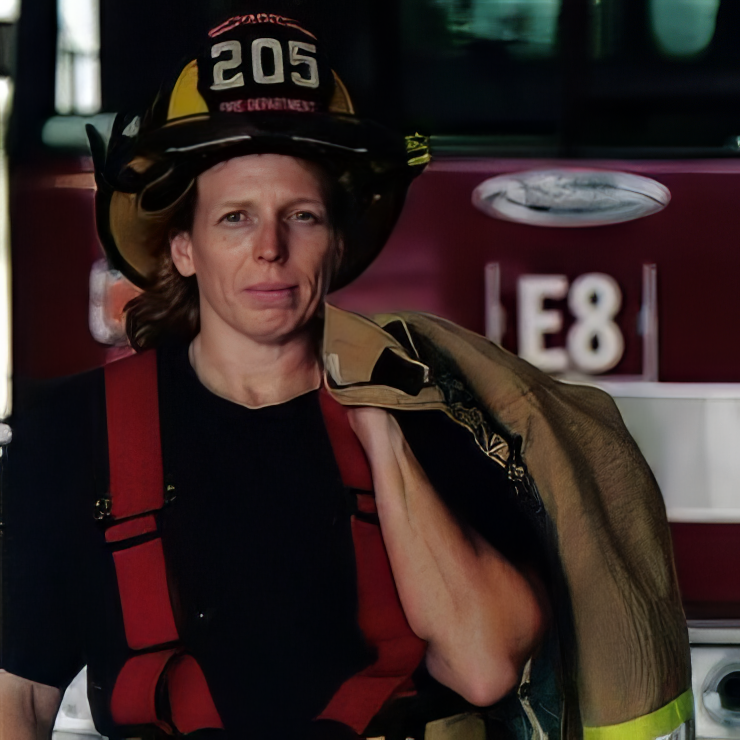
I've spent years living inside that sentence — first as a firefighter with Richardson FD, then as a breast cancer survivor, then as someone who lost her job — fired from the department after my diagnosis — and told my cancer wasn't the job's fault. Making Brotherhood, Rewritten has pushed me to go deeper into the research than I ever expected. What I found should make every firefighter — and every lawmaker — stop and pay attention.
the carcinogens are real
Firefighters don't encounter a single hazard. They encounter a compound one. Every structure fire releases combustion byproducts — benzene, formaldehyde, polycyclic aromatic hydrocarbons. Diesel exhaust from apparatus is a constant. Night shift work alone is classified by IARC as a Group 2A carcinogen. And then there's the gear.
PFAS — per- and polyfluoroalkyl substances — are embedded in turnout gear. Firefighters carry serum PFAS levels 2–10x higher than the general population. These chemicals don't stay on the outside of the body. They disrupt ovarian function. They accumulate. They persist.
IARC Group 1: what that actually means
In 2022, the International Agency for Research on Cancer elevated occupational firefighting exposure to Group 1: carcinogenic to humans. That's the same classification as asbestos and tobacco. It's the highest designation IARC issues. And it applies to all firefighters — men and women.
When IARC says "carcinogenic to humans," they mean the evidence is sufficient to conclude that the exposure causes cancer in humans. Not might. Not possibly. Does.
the gap in the research is not a gap in biology
Here's where it gets complicated — and where women get left behind.
Some cancer types come back with what IARC calls "inadequate evidence." When decision-makers see that phrase, they use it to deny coverage. What it actually means is that there isn't enough research — not that the cancer can't be caused by firefighting.
Women were historically excluded from firefighting studies. Fewer women in the data means fewer data points about female-specific cancers. The research gap exists because the research was never done. As Dr. Sara Jahnke's FFCCS Women's Study — the first rigorous study of cancer in female firefighters — has begun to document, the exclusion from studies created the exclusion from coverage. That's not biology. That's institutional neglect.
Texas law: same science, different rules
Texas covers firefighters for prostate cancer. Testicular cancer. The cancers that affect men.
Texas does not cover breast cancer. Cervical cancer. Ovarian cancer. Uterine cancer — the cancers that affect women.
This is happening under the same IARC Group 1 classification that applies to all firefighters regardless of gender. The science didn't divide us. The law did.
Female firefighters face a 46% higher breast cancer risk and a 500% higher cervical cancer risk compared to the general population. Texas lawmakers know the Group 1 classification. They chose not to place female specific cancers on the presumptive list. That is a choice, not a scientific conclusion.
12 chemicals. one conclusion.
In 2024, Cardona et al. published a landmark study in Toxics through the Silent Spring Institute — the first study to systematically map firefighter chemical exposures to breast cancer carcinogenicity evidence. They identified 12 specific chemicals present in firefighting environments that are linked to breast cancer development.
Not suspected. Documented. All 12 present in the work. All 12 linked to breast cancer. Still not covered in Texas.
the presumption principle
A Massachusetts court ruled that proving the exact cause of cancer from multiple chemical exposures is "impossible." That's precisely why cancer presumption laws exist — because the science tells us that isolating a single cause when the body has been exposed to Group 1 carcinogens for years cannot be done.
When federal cancer presumption was implemented for firefighters, acceptance rates for cancer claims jumped from 29% to 94%. Not because firefighters suddenly started getting sicker. Because the system finally stopped demanding the impossible as the price of admission.
That same logic — that same science — should apply to every firefighter. Not just the ones whose cancers happen to appear on a state-approved list.
HB 1639, signed into law in June 2025, is a meaningful first step — and it should be recognized as one. Texas took action. The study it mandated will produce real data on female firefighter cancer rates for the first time. That matters.
But a study is not yet coverage. And this fight belongs to everyone who runs in when most run out — male and female firefighters alike. Both are exposed to the same carcinogens. Both deserve the same protection when those carcinogens do what science says they do. We can do better. For all of them.
progress — and what's still needed
what comes next
HB 1639 was signed in June 2025. The Texas study results are due September 1, 2026. The data is coming.
Brotherhood, Rewritten exists to document what happens when that data arrives. To make sure the people inside this story — the firefighters who got cancer, the ones still fighting, the ones we've already lost — are heard before the political decisions get made.
The science is done. It has been done. The question now is whether the people making the laws will read it.
I need you to help make sure they do.
Support the film: https://brotherhoodrewritten.allyrafundraising.com/
Learn more: tatteredmemoriesproductions.com